The story that sells
How to talk about TMA — and the only claims you may make.
This is the narrative behind our best-performing pages and emails. It works because every line of it is true — tell it in your words.
The Movement Athlete exists because of an injury. Ten years of lifting. A 300-pound bench. And a first CrossFit session that ended in rotator-cuff surgery and six months of recovery. What rebuilt that shoulder wasn’t more weight — it was progressive calisthenics: the same movement made harder by changing body position instead of adding a plate, in steps small enough that connective tissue adapts alongside muscle.
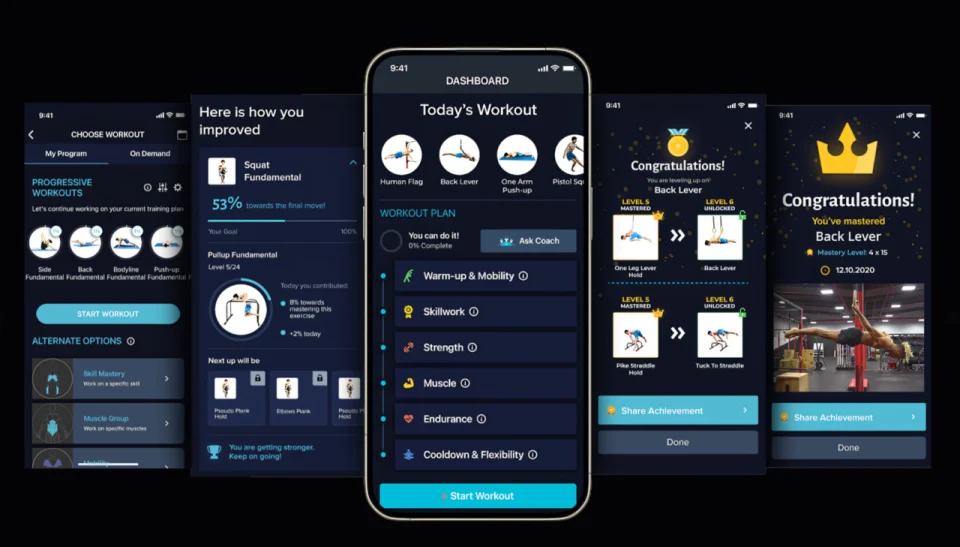
The problem was that doing it properly by hand was a full-time job. So we built the system that does it — with physiotherapists, gymnastics coaches and elite calisthenics coaches. The trainers proved it manually first, in the gym with real people: adjusting each person’s training on real-time feedback, tracking every progression by hand.
It worked — and it consumed entire days per client. That’s when it became clear technology had to be involved.
We built it in proven stages, and only ever the next one:
| Stage | What we shipped | What it proved |
|---|---|---|
| 1 | A course | That people wanted this at all |
| 2 | A web app — the 9 Fundamentals only | Proof of concept, deliberately narrow |
| 3 | The mobile app | Built with funding, backed by the LEAD Sports Tech Accelerator — run by the Adidas family and ex-Red Bull executives (exact wording, never shortened) |
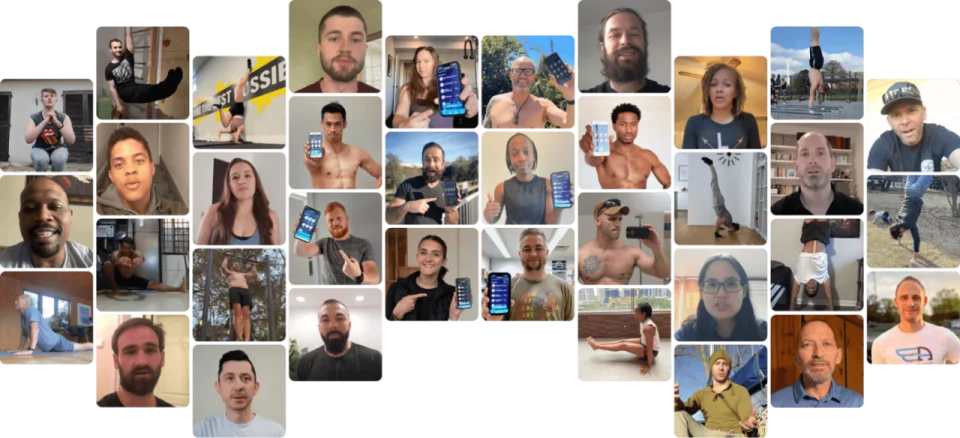
And we never guessed what to build. Surveys and interviews with the audience at every step — which is exactly why the sequence went course → Fundamentals-only web app → mobile app. Eight years on, that system has passed $1M+ in sales (audited on our payment records, net of refunds), 26,000+ purchases, 100,000+ athletes in 47 countries, and a library of 200+ video testimonials from members telling the story in their own words.
✓ Our story, and how to tell it
Please tell it as the company’s story, not as a named coach’s. We publish under our head-coach brand voice (Jesse), and we don’t put individual coaches forward for interviews or quotes — so don’t offer your audience access to one. If you need a named person on the record — press, a podcast, anything — ask us and we’ll arrange the right person.
The proof points you may use verbatim are in the rules; the injury story above is yours to retell in your own voice.
✕ What we never say — and neither may you
The full rules live on the rules page. Short version: no medical or healing claims, no income claims, no “guaranteed results”, no invented reviews — and the rating is 4.8★, never 4.9.
THE POSITIONING BLOCK — USE IT AS WRITTEN
This is why we built The Movement Athlete.
- Not another workout app.
- Not another 8-week programme that ends and leaves you hanging.
A complete system that builds capable humans — for life. Taking you from zero, step by step, to some of the most advanced calisthenics skills — while building real strength, mobility and healthy joints, and having fun on the way.
- Built by a team of coaches and movement specialists.
- Backed by a leading startup accelerator — the LEAD Sports Tech Accelerator, run by the Adidas family and ex-Red Bull executives.
- Featured in Forbes, Men’s Health, Men’s Fitness, LIVESTRONG, HuffPost and askmen, and shown alongside Red Bull, NewsWatch, AMC and SportsTech Ireland.
- Trusted by 100,000+ members across 47 countries.
The press line — the full verified set
These eleven are the ones listed here, and they are the band that runs on our own site:


🔴 The logos are white, so they only show on a dark or coloured background — on white they disappear. One correction to older copy: it is 47 countries, not 195. The Guardian is not in this set, so do not use it; everything above is fair to claim.
Jesse’s story — the version to tell
This is the story that does the work. Tell it in your own words; keep the shape.
Fifteen years ago I was shown calisthenics and I was sceptical. I had always been a fan of weightlifting and I was not sure bodyweight work would give me the same results.
But by then my big muscles and my stiff joints spoke for themselves. Shoulder pain. Constantly recovering from something. A limited range of motion. All that effort, and there I was — looking big and incapacitated by my own body.
Weightlifting is a great form of training and it has its place. But too much of it, too heavy too soon, with bad form, is hard on you. And without mobility to balance it, it is a recipe for disaster. That is where I ended up, in my late twenties, in pain.
Progressive bodyweight training opened a different world. The progressive part challenged me in new ways and I improved week after week — strength and mobility together, and lean muscle with it.
The line underneath all of it: you want to be strong, but you also want to be mobile enough to use that strength. Otherwise what is the point?
And why the company exists at all
Before TMA was a platform, it was coaches. That origin is the most persuasive thing about the product, because it explains why it behaves the way it does.
We were personal calisthenics coaches trying to help people move better. Nearly every person said a version of the same thing: “I’ve been lifting for years, but now my joints hurt.” “My shoulder is wrecked and I don’t know where to start.” “I’ve got muscle, but no mobility and no control.”
So we coached every client by hand — full assessments, personalised progressions, in-workout adaptations, careful layering of strength, mobility and recovery. And it worked almost too well. People got stronger and more mobile, pain went down, confidence went up.
But there was a limit. Not everyone can afford private coaching, and we were burning out. They needed a system — one that adapts like a coach but scales.