Everything we know about selling The Movement Athlete. Now it's yours.
The three buyers who actually pay. The story that converts. The ads and the
emails that carried the first $1M, the assets to build with, and the claims that keep you
safe. Adapt it to your voice — the best partner content has always been personal, never
copy-pasted.
— Jesse, Head Coach
100,000+ athletes4.8★ member rating47 countries2,000+ exercise variations100+ skills with full progressions60-day money-back guarantee
The training experience, its five cornerstones, and the facts behind the recommendation.
TMA is more than a workout library. It is a progressive calisthenics training system that finds your starting point, develops strength, mobility and control step by step, and adjusts the challenge through your feedback, so you know what to work on next.
Product in 60 Seconds
What it is
A personalised calisthenics training app and an ongoing progression system, not a fixed-duration challenge.
Who it is for
People who want strength, mobility, body control and meaningful skill progress, with structured training that fits their starting point and available time.
Core promise
Build a stronger, more mobile and more capable body through consistent, progressive training.
Mechanism
Granular assessment, microprogressions, effort feedback, integrated holistic workouts and a gamified mastery journey.
Key difference
The combination: find the right starting point, follow manageable next steps, develop the capacities a movement needs and adjust the challenge as you train.
Strongest proof
Show the actual assessment, progression and workout screens, supported by a relevant real member story. Product demonstrations explain the mechanism; member stories illustrate individual experiences.
Safest CTA
“Take the free quiz to explore where to start.” Use your issued partner link. The fuller movement assessment happens inside the app after joining.
Current referral clarification: Quiz referral tracking is confirmed. The 50% offer supports a tracked partner link and an optional partner code at checkout. Use the link or code issued to you; do not invent a code or promise a trial on a discount path.
Start with the snapshot, explore the five cornerstones, then choose the customer problem, proof and message that fit your audience.
Customer Problems TMA Solves
Two layers: what people want, and what their training is missing
The two situations below are illustrative summaries. The six member quotations that follow are the preserved source wording.
The life problem: “I want to feel strong and capable again. I am stiff, stuck, short on time, or unsure how to begin.”
The programme problem: “I tried training, but the steps were too big, the workouts were rigid, or I had to figure out the plan myself.” These are different entry points into the same product. Start with the customer's experience, then explain the TMA mechanism that answers it.
First, the problem your audience actually has
Nobody buys a training system because they want a training system. They buy because something has already failed them. These six failures came out of our own members telling us what went wrong before they arrived — and your reader has lived at least one of them.
The steps were too big
“The other apps at some point were just too hard. The steps they were taking were just too big. Unrealistic, very disappointing.”
TMA response: Microprogressions Small intermediate steps instead of a leap to the final skill. See the product evidence
No structure at all
“I’ve tried a few other bodyweight apps, but they sort of left you to make it up as you go along. No structure, just some random routines.”
TMA response: A connected programme Assessment, guided sessions and a visible progression path. See the product evidence
Rigid, so it hurt them
“It’s so rigid in moves and reps. I did not make any progress — instead I got myself an injury by trying exercises that were too hard for me.”
TMA response: Difficulty feedback Report the effort and adjust the challenge; never train through pain. See the product evidence
No way to adjust it
“I had the greatest problems with the duration of the workouts, which I couldn’t adjust. A lack of variation and long-term motivation.”
TMA response: Practical workout settings Build training around available time and equipment. See the product evidence
Too many decisions
“You can get a bit of help through YouTube videos and all of that, but I really struggled to put a comprehensive training program together.”
TMA response: Less planning A complete session instead of assembling unrelated tutorials. See the product evidence
Strong, and still breaking
“I ended up getting stronger and maybe not so mobile, with some impingement in my shoulder — and that’s when I thought, okay, something needs to change.”
TMA response: Holistic development Mobility and flexibility belong alongside strength and skill. See the product evidence
The sentence underneath all six: “It was not built for a body like mine, today.” That is the problem TMA solves, and it is the one your content should name.
Match the situation, not a single fitness label
Audience situation
What matters to them
Relevant part of TMA
Beginners intimidated by calisthenics
A manageable place to start, not advanced moves on day one.
Movement-specific assessment and foundational progressions.
Over-35s feeling stiff or stuck
Strength alongside movement range and control.
Integrated mobility, flexibility and progressive training.
Former athletes returning to training
A route from current ability, not pressure to match their old performance.
Personalisation, feedback and visible milestones.
Gym-goers wanting more mobility and body control
Develop capacities beyond familiar lifts.
Holistic sessions and movement-based goals.
Skill seekers
A structured path towards handstands, muscle-ups or levers.
Prerequisites, microprogressions and the mastery map.
Busy people training at home
Less planning and a programme that fits their time and equipment.
Guided sessions and practical workout configuration.
Audience situations can overlap. A former lifter can also be a calisthenics beginner and a busy parent. Choose the relevant motivation without treating a persona as a diagnosis or a measured revenue segment.
A stronger, more mobile and more capable body, built through an ongoing practice of progressive calisthenics. The everyday benefit and the skill journey support each other: skills provide meaningful targets, while the work towards them develops physical capability.
Know where to start: replace a broad fitness label with a starting point for each movement.
Know what comes next: follow a structured progression rather than assemble unrelated routines.
Develop more than strength: mobility, flexibility, technique and control belong in the training process.
Respond to today: use effort feedback instead of forcing the same target regardless of how the work feels.
See a purpose: milestones and skills make long-term training tangible and engaging.
Reduce the planning burden: focus on training rather than constructing the whole programme yourself.
Progress is not a personal best every session. Recovery, practice and repeated exercises are part of the process. “For life” describes the training philosophy; lifetime paid access is a separate offer with its own terms.
Capability is the aspiration. “Invincible” is a metaphor, not a promise of injury-proof or pain-free outcomes. Connect each benefit to a demonstrated feature or an attributed member experience.
A fitness journey that actually matters
Start where you are and build the foundational blocks of strength, mobility and capability. Invincible expresses the aspiration, not guaranteed pain-free or injury-proof outcomes.
That is the sentence under everything. Not a body that looks trained — a body that works, built one block at a time, in an order that holds.
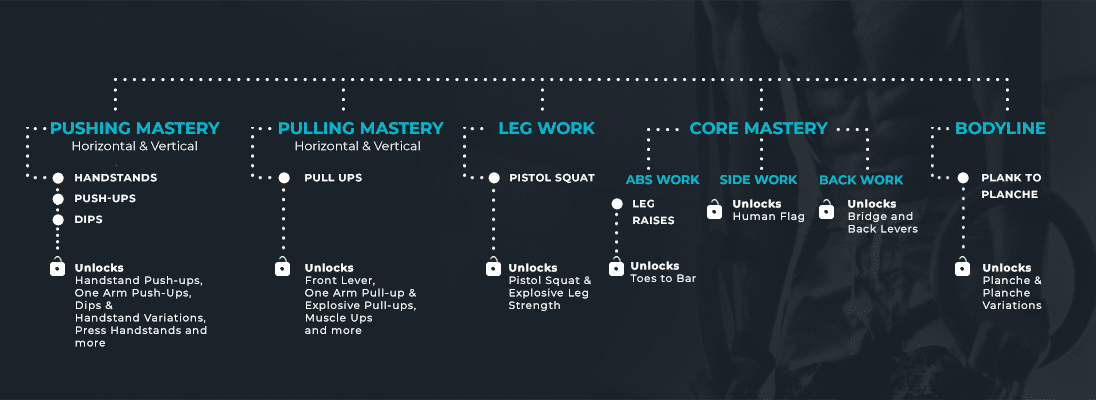
The five mastery blocks — pushing, pulling, legs, core and bodyline — and what each one unlocks above it. Progress on a block opens the skills that sit on top of it.
“I joined TMA while recovering from an injury. I searched everywhere for a fitness app that offered more than just aerobics or high-intensity workouts. I needed something that focused on flexibility and mobility alongside strength. What truly impressed me about TMA is its incremental building blocks approach. Each workout is designed to strengthen your body as a whole, one step at a time, ensuring a balanced and comprehensive fitness journey.”
A real member, in their own words — and a near-perfect summary of the product. Use it when you need one quote that explains the whole thing.
What “invincible” actually means
The aspiration is a more capable, resilient body, not literal invincibility — and that word has a specific meaning here, which is what makes it usable rather than hype:
Functional strength that shows up in real life
Strong in the movements the day actually asks for, not strong in one machine.
Muscle that supports movement instead of restricting it
Lean and in proportion. Muscular without being boxed in by your own size.
Freedom to move any way you want
Bend as low as you can go, jump, twist, reach — without negotiating with your body.
Joint capacity and movement confidence (not injury-proof joints)
Limber, leaner, faster and markedly more resilient — as a training aspiration, not proof that bodyweight loading prevents injury or that external weights damage joints.
Mobility, movement confidence and long-term practice
Progressive calisthenics trains connective tissue and joints specifically. Some members describe returning after injury; those stories are not medical rehabilitation claims or proof of prevention.
Endurance that carries the day
Muscular endurance you feel at 6pm, not just in a set.
The Five Cornerstones of the TMA Experience
These are the foundation of the experience, not optional features. Personalisation finds the starting point; microprogressions provide the path; autoregulation adjusts the challenge; holistic development builds the capacities needed; gamification makes the journey visible and motivating.
Why the integrated system matters
If you want to explain why it works rather than what it is, this is the material. The differentiator is how these principles work together in one ongoing system.
1. Granular personalisation
You have an ability profile, not one fitness level. You might be further along in push-ups than pull-ups, and strength alone does not describe your mobility or skill. TMA positions training at the level of individual movements instead of treating one label as the answer for everything.
Too easy
Too little challenge for the intended strength adaptation. Useful practice and recovery can still have value, but the progression may need to move forward.
Appropriate challenge
Demanding work at your current movement level, with controlled execution and manageable next steps. This is the target, not a guarantee of progress every session.
Too hard
Demands beyond current capacity can lead to compensation, reduced range or poor execution and may increase injury risk. Adjust the challenge; do not push through pain.
The same workout can be too easy for one person and too hard for another. Assessment finds a starting point for each movement; ongoing feedback helps keep the work appropriately challenging.
The Goldilocks zone
Too hard may encourage compensation and increase injury risk. Too easy may provide too little stimulus for the intended adaptation. Every workout has to be just right — hard enough to force adaptation, manageable enough to support continued practice and recovery.
This is the part that is almost impossible to do for yourself, and it is why most people burn out, break down, or stay stuck for years.
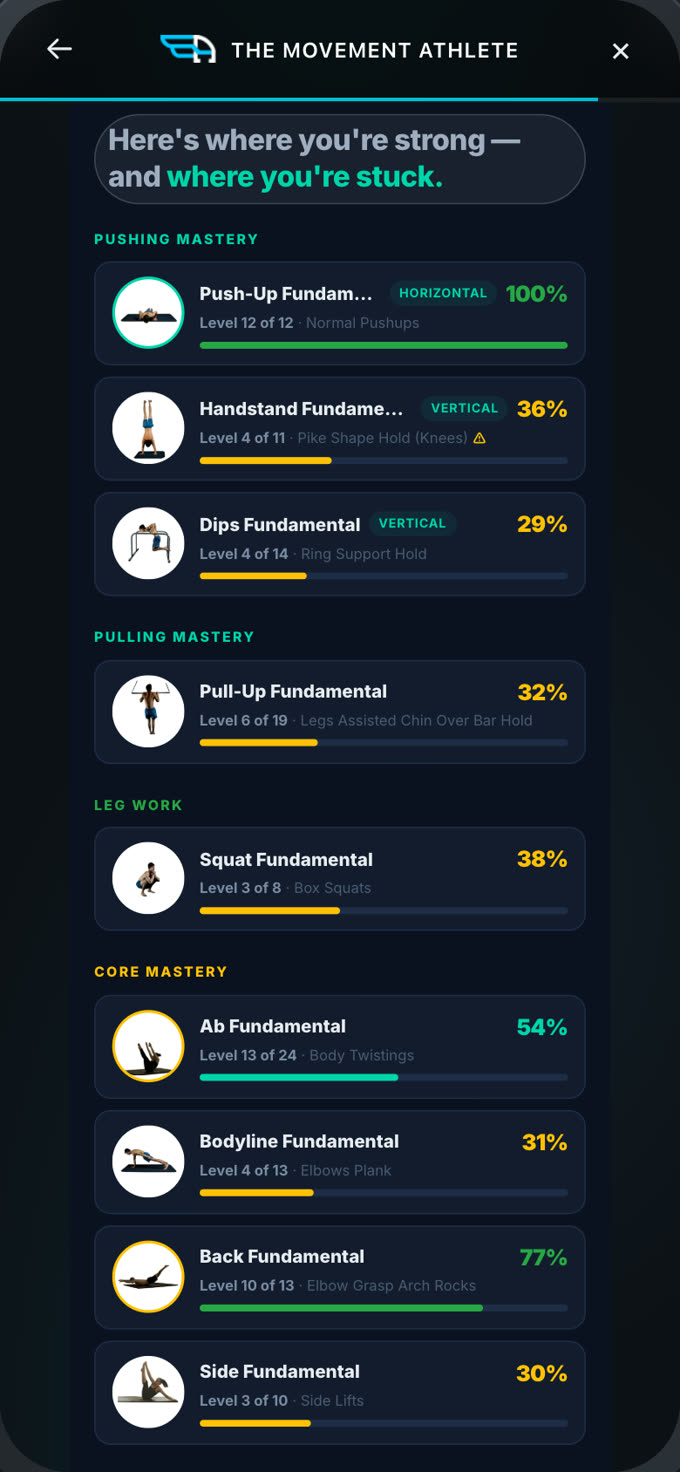
Actual assessment-results example. Open the image to inspect the full screen.
One person. Different starting points.
Push-ups: level 12 of 1212 of 12Normal push-ups. A well-developed pushing foundation.
Handstand: level 4 of 114 of 11Pike shape hold on knees. Handstand development starts elsewhere.
Pull-ups: level 6 of 196 of 19Legs-assisted chin-over-bar hold. Pulling follows its own path.
Squats: level 3 of 83 of 8Box squats. Another movement, another entry point.
Affiliate message: “You are not one fitness level. Your starting point can be different for each movement.”
These indicators show positions in the programme, not a clinical test or an overall fitness score.
The linked article discusses Dr. Tilly's coaching explanation. Its 20-gymnast example is an illustration, not a TMA clinical trial or a measured outcome. A primary research citation is needed before presenting it as study evidence.
True personalisation
Training starts with an assessment that establishes movement-specific starting points and relevant mobility and flexibility needs; it does not diagnose imbalances or certify medical readiness. Then it builds a programme that is actually theirs — not a template with their name on it.
Why almost nobody does it right
This is what makes TMA a product rather than a YouTube video — and it’s the strongest
thing you can say about us:
The steps have to be the right size — and the right size is small. Muscle and connective-tissue adaptation do not follow one universal timetable. Jump too far between variations
and the muscle writes a cheque the joint can’t cash — an abrupt increase may exceed current capacity. Steps that are too easy may not provide enough stimulus for the intended adaptation. TMA uses small intermediate steps. The historical 5–10% shorthand is not a validated measurement of every step.
Nobody is at the same level in every direction. You might push well and
pull badly. Your shoulders might be strong but stiff. A single “beginner / intermediate /
advanced” label is wrong for the same person in nine different ways at once — which is why TMA
positions you separately on every one of the 9 Fundamentals.
Doing it properly is a full-time job — per person. Our own trainers did
exactly this by hand: know each client’s precise step on every movement, watch every session,
adjust the next one. It worked — and it consumed entire days for one client. The system is
what makes a coach’s method available to a hundred thousand people at once.
2. Microprogressions
Make the next step manageable. Progressions bridge the gap between what someone can perform now and a harder movement. Changes in leverage, range, tempo, stability, volume or complexity can alter the training challenge; progression is not only adding more repetitions.
Repeat an appropriate variation while building capacity; moving on is not required every session. The change can be a body position, a hold duration or less support — not a leap straight to the finished skill.
Micro-progression, in the right order
You cannot throw exercises at a body and hope it works it out. There is a sequence. Each skill builds on the last. Skipping prerequisites can leave missing capacity and may increase difficulty or risk. This is engineering, not inspiration.
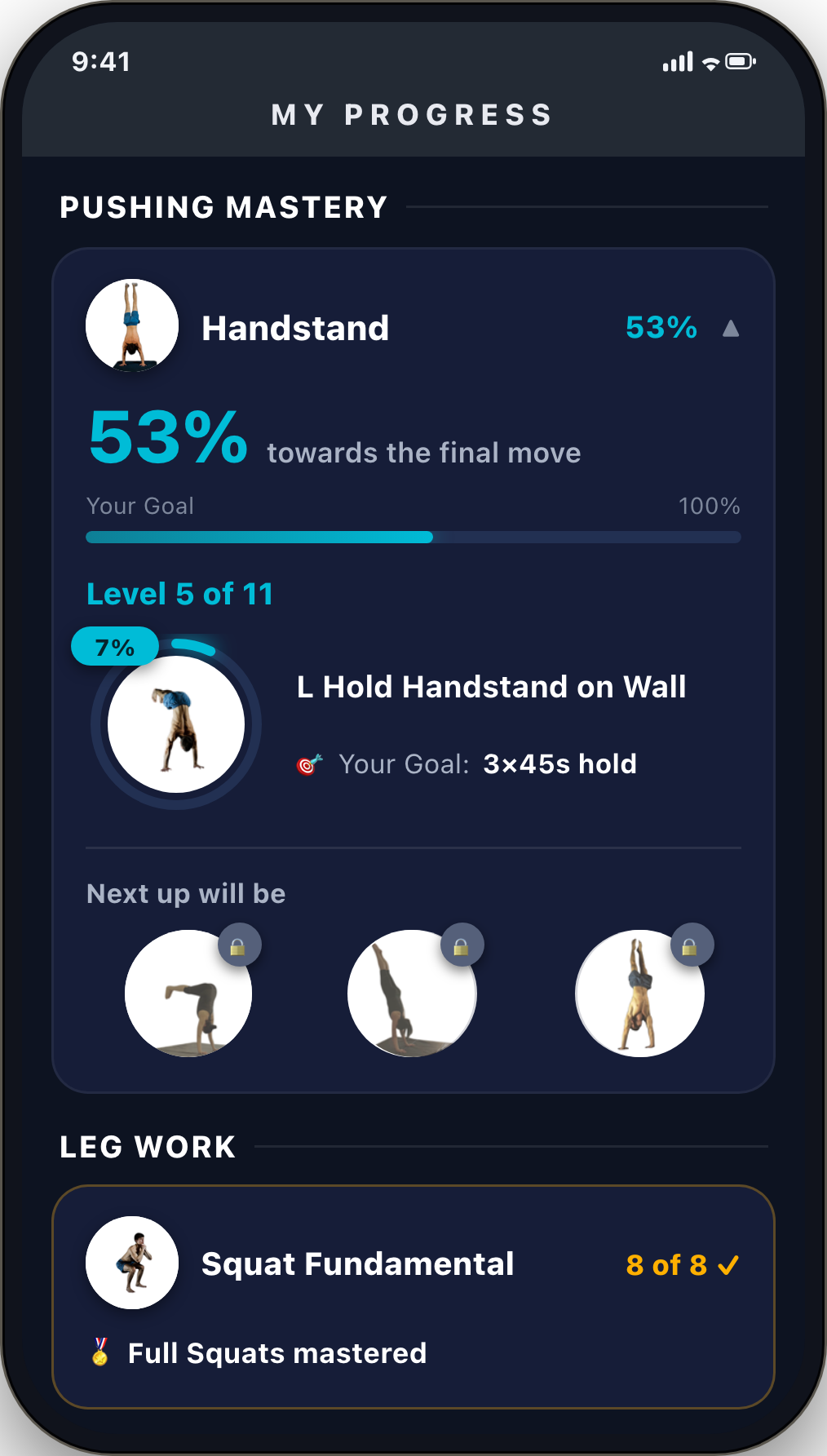
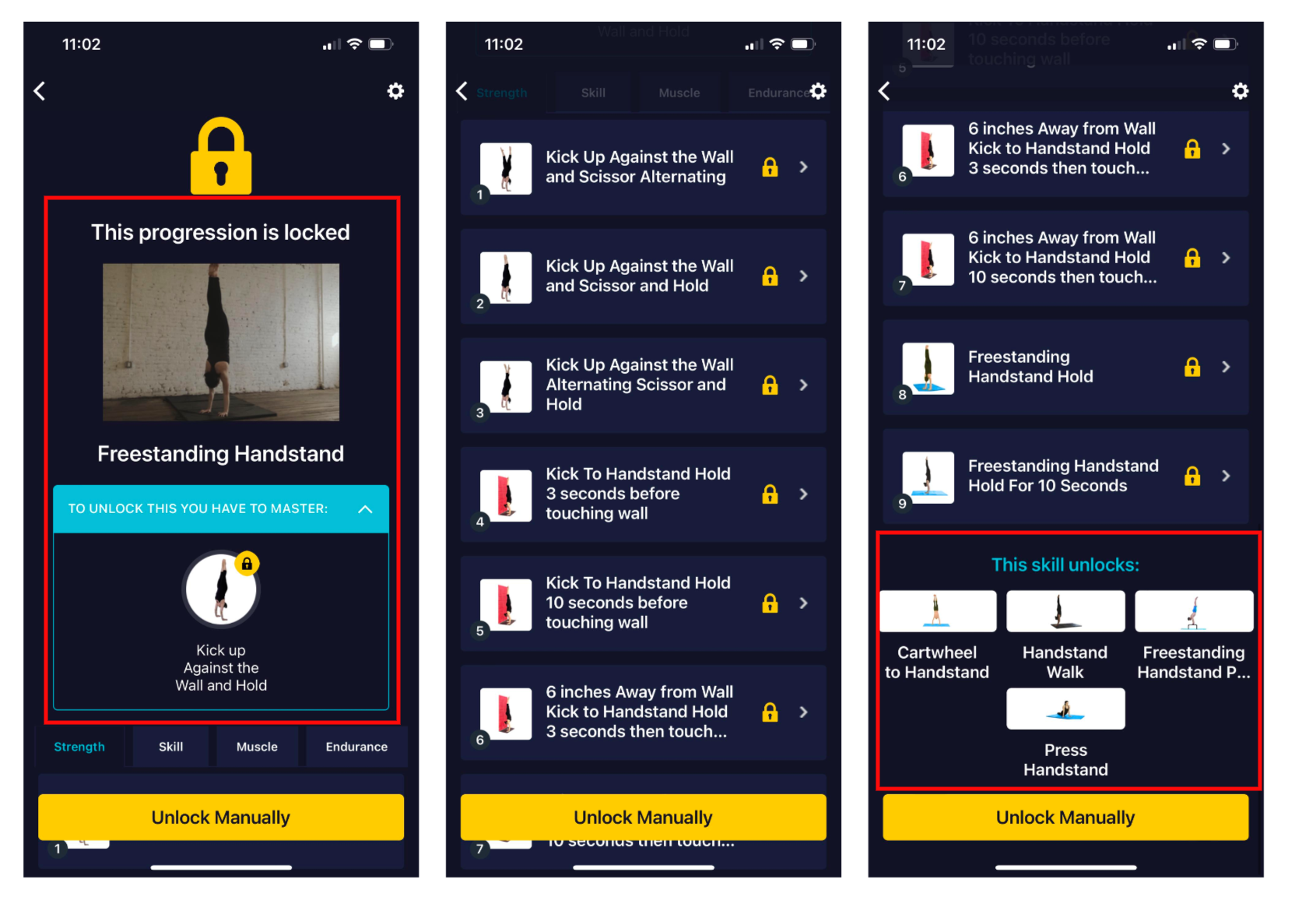
Actual screens from the handstand article: prerequisites on the left, intermediate variations in the middle, later holds and linked skills on the right. This is an excerpt, not the whole foundational path.
Establish the prerequisite
The pictured freestanding path starts from the kick-up against the wall and hold.
Reduce reliance on support
Practise controlled scissor variations and short holds before touching the wall.
Build the unsupported hold
Progress towards a freestanding hold and longer controlled practice, according to the member's path.
Affiliate message: “Show the steps between now and the skill — not just someone performing the finished move.” The screen includes manual unlock controls; an unlock is not medical clearance.
3. Autoregulation
Today's capacity is not yesterday's capacity. TMA uses your reported exercise difficulty to adjust the training challenge. The five-point effort feedback loop adds continuing personalisation to the initial assessment; it can inform the following set and subsequent training.
Autoregulation
Your body is different every day. Static programmes do not care. This one asks how you are and adjusts: feeling strong, it pushes; running on fumes, it dials back and works technique. A coach who actually pays attention.
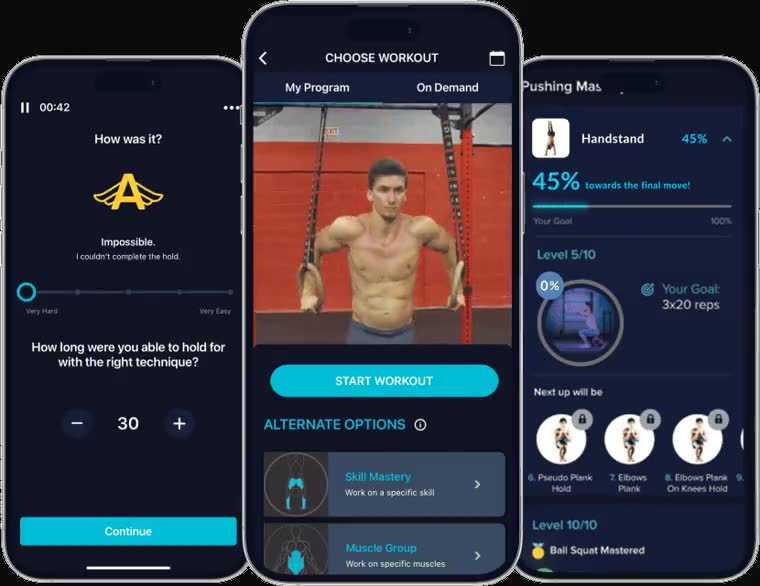
The left-hand app screen asks “How was it?” and records how long the member held with the right technique. The rating is reported by the member, not sensed by the app.
Perform the exercise
Work on the prescribed movement or hold and record what you completed.
Report the difficulty
Use the five-point effort scale. Today may feel different from the last session.
Adjust the challenge
The feedback informs the next set and ongoing programme. Sets, reps and exercise demands are not an instruction to ignore pain.
Affiliate message: “Tell the app how challenging the work feels, and it adjusts the challenge.” Do not imply independent sleep sensing, medical assessment or automatic form observation.
The screen documents the input; the short demo below shows the app building a session. Neither is a verified numeric before/after comparison, so do not invent changed repetitions for it.
“Just right”, recalibrated daily
Too hard? Difficulty beyond current capacity may lead to compensation or poor execution. Reduce or adjust the work; pain is not a target to push through.
Too easy? The stimulus may be insufficient for the intended strength adaptation; easier practice and recovery can still be useful.
Just right? The aim is productive work with manageable recovery and progress across repeated practice, not a guaranteed recovery interval or improvement tomorrow.
TMA holds you in that zone with three mechanisms: the assessment defines your
exact entry point on every movement · micro-progressions make the next step
manageable rather than a jarring jump; the 5–10% shorthand is not a measured universal rule · daily calibration adjusts to your
feedback, energy and recovery — session by session, not month by month.
Every session covers all
six elements: warm-up/mobility, skill, strength, muscle, endurance, cooldown/flexibility.
The app in motion — a personalised session being built. Show the product doing
this; it sells better than any claim about it.
The scale of the map: the 9 Fundamentals — push, pull, dips, handstand, core,
side, back, bodyline, squat — carry 100+ progression levels between them, and
above them 100+ skills branch out (muscle-ups, front and back levers, the human
flag, the planche), each with its own ladder of small steps. 2,000+ exercise
variations in total.
Every step manipulates six levers: leverage, tempo, range,
stability, volume, complexity.
4. Holistic development
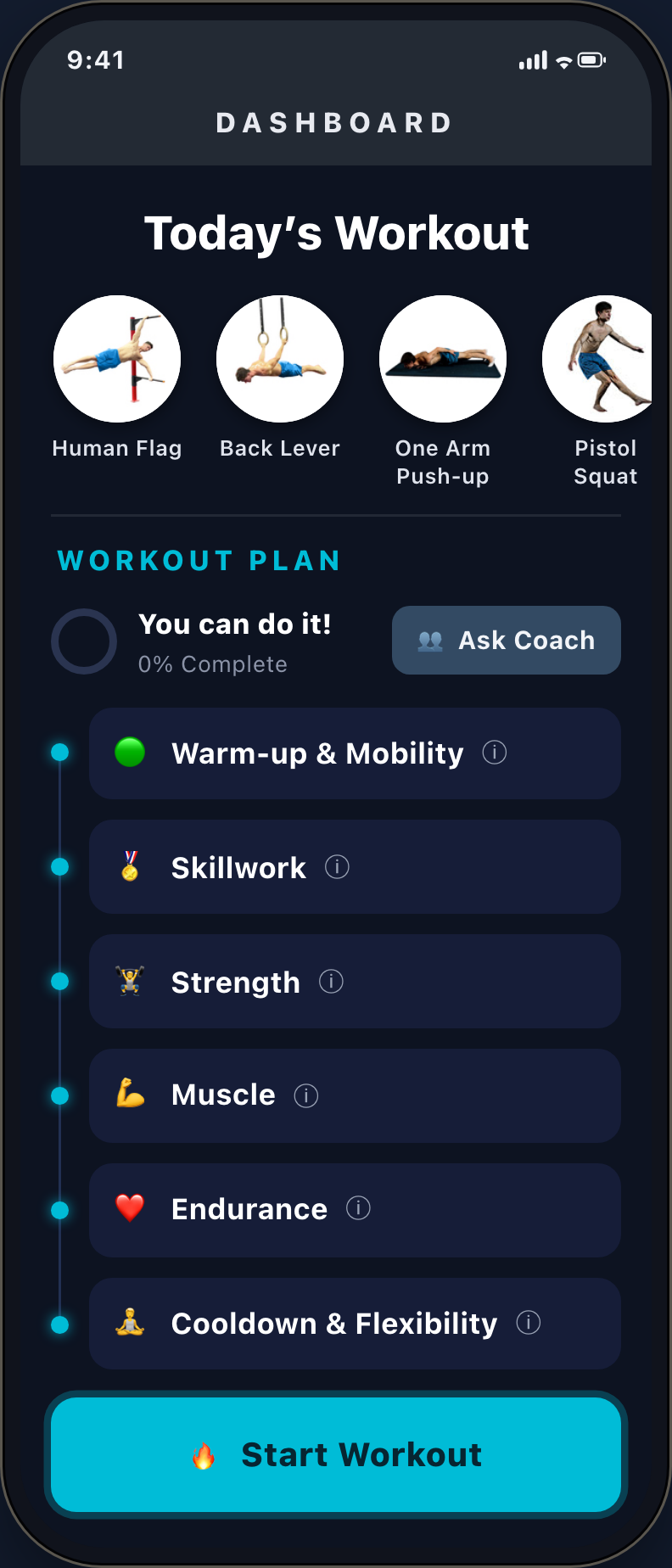
Develop the whole movement, not only one ingredient. TMA's complete workout structure integrates warm-up and mobility, skill, strength, muscle, endurance, and cooldown and flexibility. Mobility and flexibility are built into every TMA workout, not left as a separate programme for the member to assemble.
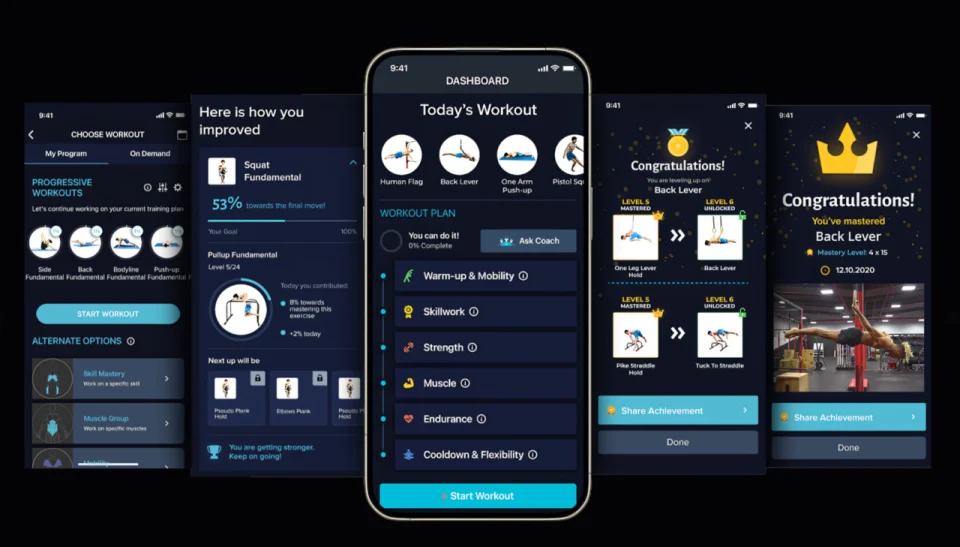
The six-part session: warm-up & mobility → skill → strength → muscle → endurance → cooldown & flexibility. See every element and the actual workout screen. These six workout elements are different from the five product cornerstones.
1. Warm-up & mobilityPrepare and practise movement range.
2. SkillPosition, balance and control.
3. StrengthAppropriately challenging work.
4. MuscleProgrammed resistance-training volume.
5. EnduranceSustain the work or position.
6. Cooldown & flexibilityFinishing work and flexibility practice.
Holistic workouts
Every single session contains all six elements — warm-up & mobility, skill, strength, muscle, endurance, cooldown & flexibility — developing strength, skill, muscle, endurance and mobility together. Each contributes something different to the complete session. It is a house with a missing foundation: looks fine, until it doesn’t.
5. Gamification and mastery
Make progress visible and give practice a purpose. Movement maps, mastery indicators, milestones and skill unlocks connect individual sessions to a longer journey. Skills are both meaningful goals and a way to organise development, not merely tricks or decorative rewards.
Know your position. Current progress and the next movement make the goal concrete.Reach a milestone. A level-up marks an achievement in the programme.See what you have built. The skill recap connects the achievement to the journey.
Affiliate message: “See what you are working towards and unlock new capabilities along the way.” A mastery indicator is a programme measure, not medical clearance. Gamification supports motivation; no measured retention ranking is claimed here.
How the cornerstones work together: a handstand journey
Find the starting point: establish the member's current movement abilities rather than infer handstand readiness from lifting experience.
Build the missing pieces: work on appropriate preparation, shoulder range, body alignment, balance and strength.
Practise manageable steps: use the relevant preparatory and supported variations before more demanding practice.
Adjust through feedback: respond to reported difficulty instead of treating the original target as compulsory.
Track meaningful progress: use the progression and mastery view to connect today's work to the longer-term skill.
This illustrates the training logic, not a universal handstand prescription or a promised timetable.
Small steps describe the programming approach. The historical “5–10% harder” shorthand is not a validated measurement across every movement. Matching challenge does not guarantee injury prevention or improvement every workout.
How It Works: The Customer Journey
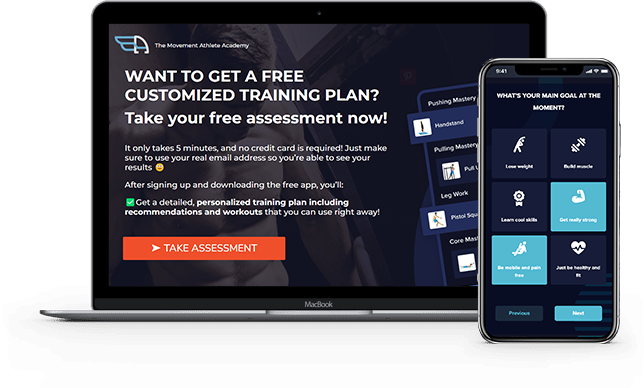
Take the free web quiz: answer questions about goals and starting circumstances. It is an initial orientation, not a physical movement test.
Explore a starting point and offer: see the route into TMA and review the membership offered on that path.
Join through the approved web route: check the price, trial eligibility, renewal and guarantee before proceeding. Discount routes and trial routes are not interchangeable.
After joining, the in-app experience follows the assessment, programme, workout and progression sequence shown below. Progress is an ongoing journey, not a fixed deadline.
Quiz referral tracking is confirmed. Send audiences through your issued partner link. A partner code is also available for the supported checkout offer when the customer prefers to enter it. Keep the quiz, membership checkout and in-app movement assessment distinct in your explanation.
This is exactly what your reader meets after they click. Knowing it means your content can hand off into it instead of repeating it.
1Athlete assessment
It starts with the free 3-minute web quiz, which places them; the comprehensive two-part athlete assessment then runs in the app and measures their actual level of strength, mobility and flexibility on every progression.
Together: not a label like “beginner” — a position. (Keep the two straight in your copy: the quiz places, the in-app assessment measures.)
🔴 It takes about three minutes. Some older artwork says five — use three.
The assessment opens on one question about their goal.
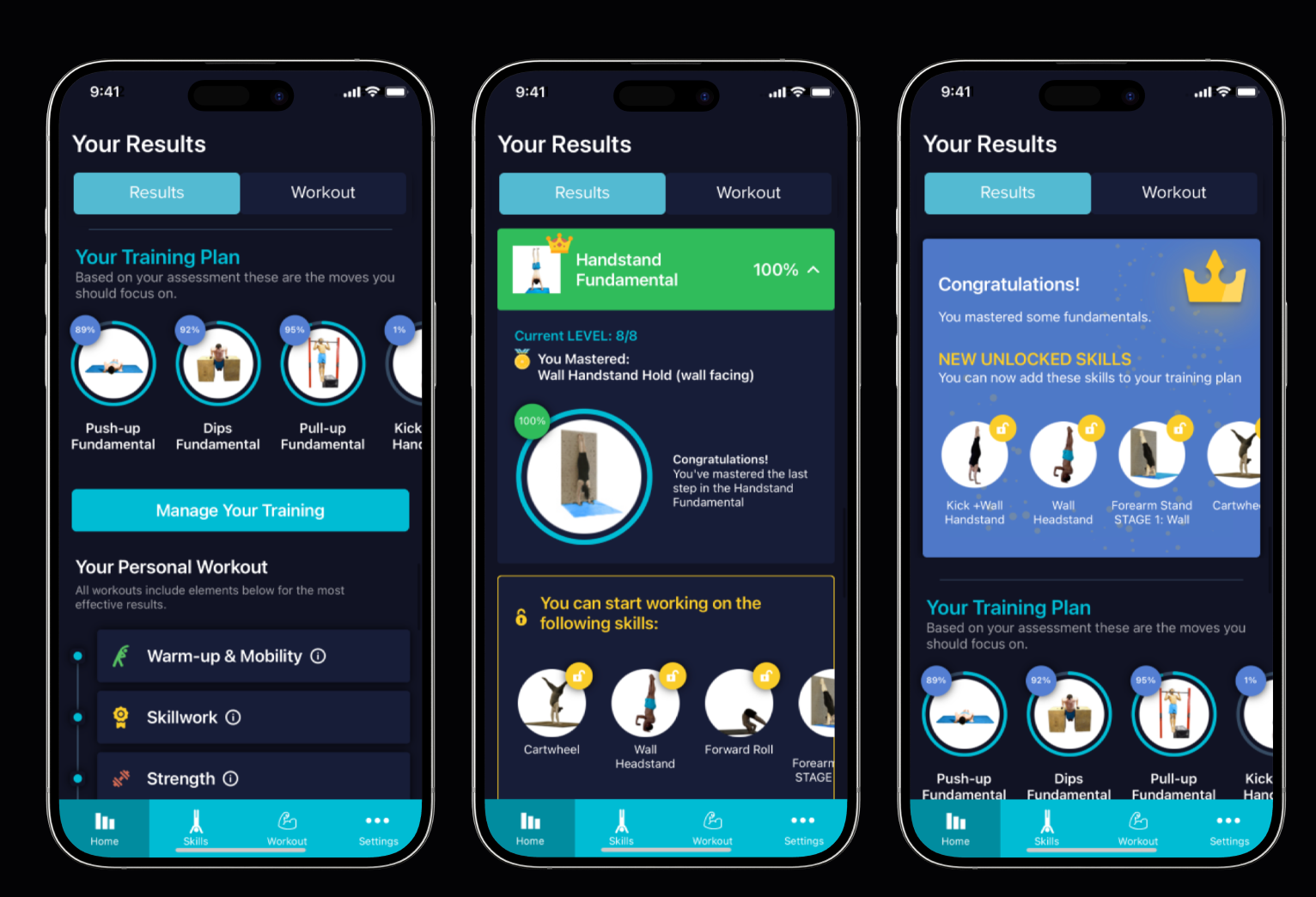
2Review your results
They see where they stand on every fundamental, and what it unlocks. This is the moment the product stops being an idea and becomes theirs.
Their results: every fundamental, their level on it, and the skills it opens.
3A game plan for their journey
The system establishes the exact sets and reps for optimal progress, and lays out a detailed path to a chosen skill starting from where they actually are.
The plan, and the skill map it is building towards.
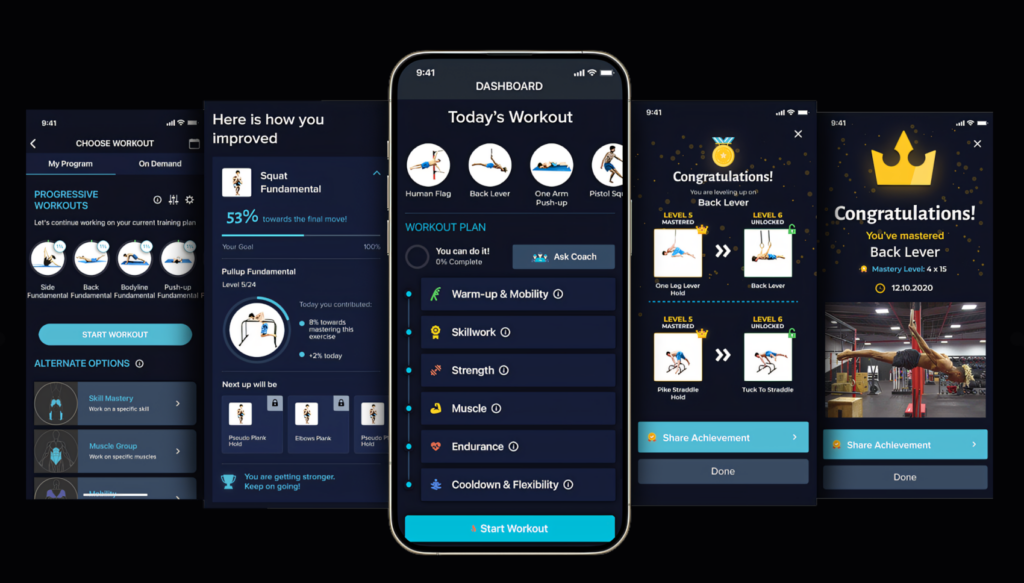
4Smart, fully personalised workouts
Built by a multidisciplinary team of coaches. Each session is personalised to their current ability and uses feedback to adjust the challenge over time. It fits their schedule, their equipment and the energy they actually have today.
The daily workout, across the app.
5Step-by-step progressions
A personalised path, visible progress they can watch move, and a mastery system showing programme progress and suggested next steps, not a medical safety clearance.
An excerpt of the handstand progression: the current percentage and some upcoming levels, not the entire ladder.
6Keep unlocking new levels
Master one move and it unlocks the next, like a game. There is always a new target, and they can always see how far they have come.
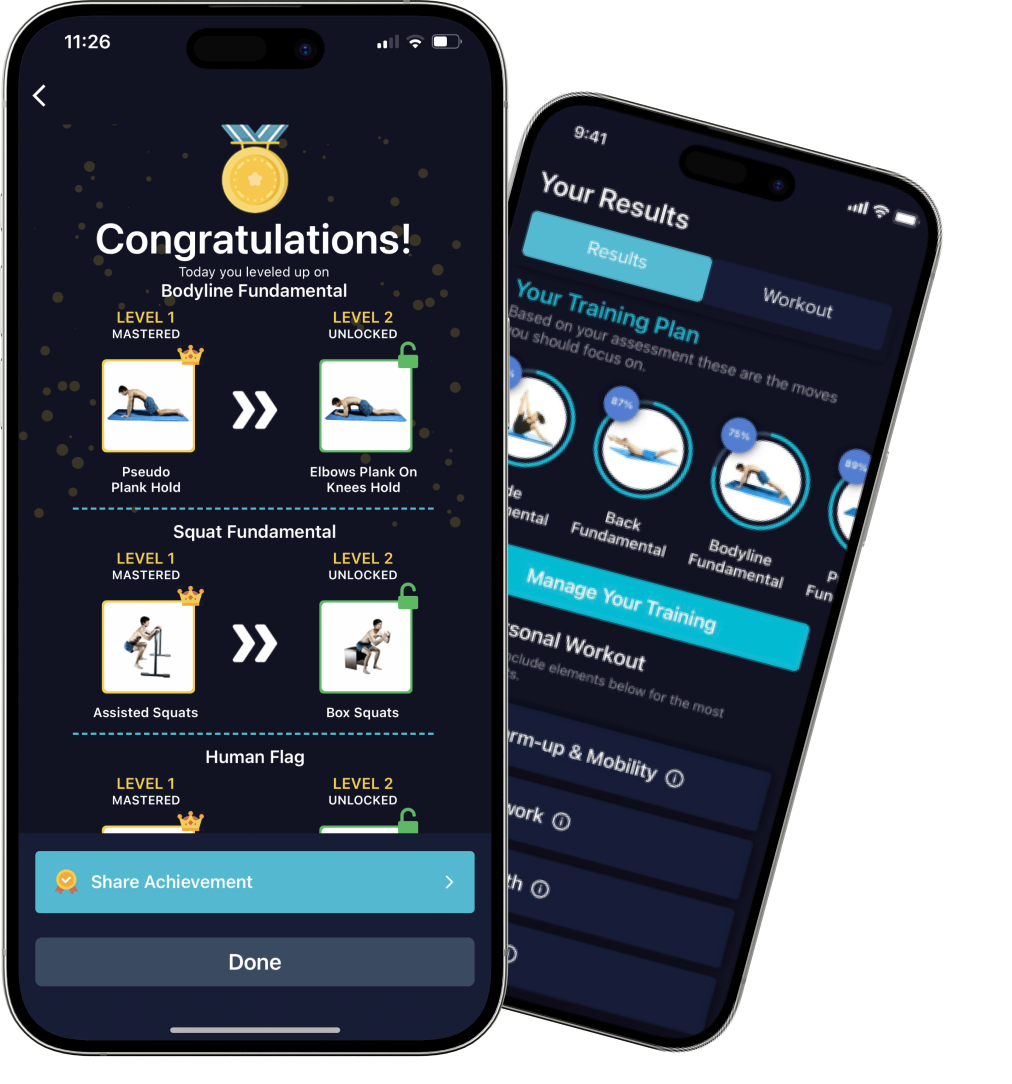
Levelling up — the moment members screenshot and send to us.
7Track broader training results
Strength, mobility and skill goals developed through continued practice; pain-free outcomes are not guaranteed. Members report real changes in strength, mobility, flexibility, muscle and endurance, and say they feel revitalised with it.
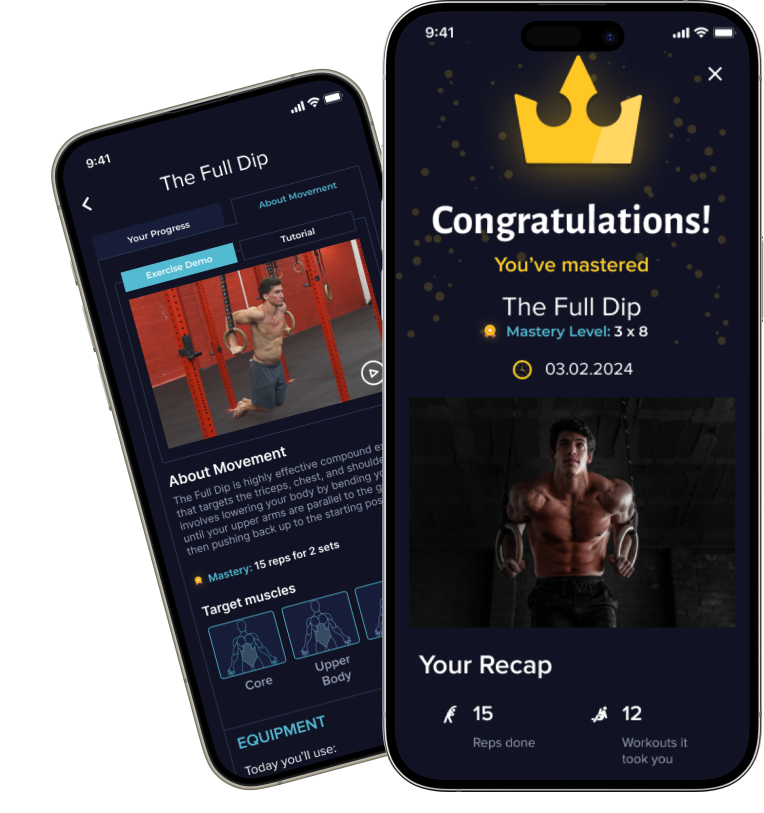
A skill mastered, with the recap of how they got there.
Inside a TMA Workout
A complete session is more than the main exercise list. The workout system includes six complementary elements. Mobility and flexibility are built into every workout, from preparation to the finishing work.
A useful demonstration: show preparation, one main movement, the effort-rating control, the resulting adjustment and the finishing flexibility work. That communicates the experience more clearly than an exercise count alone.
The complete-session structure is a key TMA difference. Describe that integration specifically rather than claim no other app offers it without a current competitor audit. Confirm the session mode when discussing short or specialised sessions.
The complete six-element session — and the email angle it supports
Calisthenics is hard to program because it is not one thing. You can have the strength for a handstand and still not hold one, because your shoulders will not go there. There is a skill to it. There is the endurance to stay up. And there is the muscle to support all of it.
The TMA complete workout combines all six elements rather than leaving the member to assemble them. Show the complete-session structure as a concrete difference; broad exclusivity needs a current competitor audit.
Warm-up & mobility
Primes the body and builds joint health into the session itself.
Skill work
The technique. Low intensity, low volume, all attention — this is what makes the strength work land.
Strength work
The main event. Sets and reps optimised for strength, and the movements that chart their progression.
Muscle work
Lower intensity, higher volume. A bigger muscle has the potential to become a stronger one.
Endurance work
Holds and work capacity — the ability to stay in a position, not just reach it.
Cooldown & flexibility
Recovery and range, which is where the mobility gains actually consolidate.
All six, in a single day’s workout. A built product screen, not a photograph of a phone.
A line you can use as-is: “Most programs give you exercises. This gives you a session — warm-up, skill, strength, muscle, endurance and cooldown — built around where you are today.”
Skills, Microprogressions and Mastery
A skill is a bundle of requirements. Handstands, muscle-ups and levers can depend on strength, mobility, technique, coordination and endurance. Working on the missing component can matter more than simply attempting the finished move repeatedly.
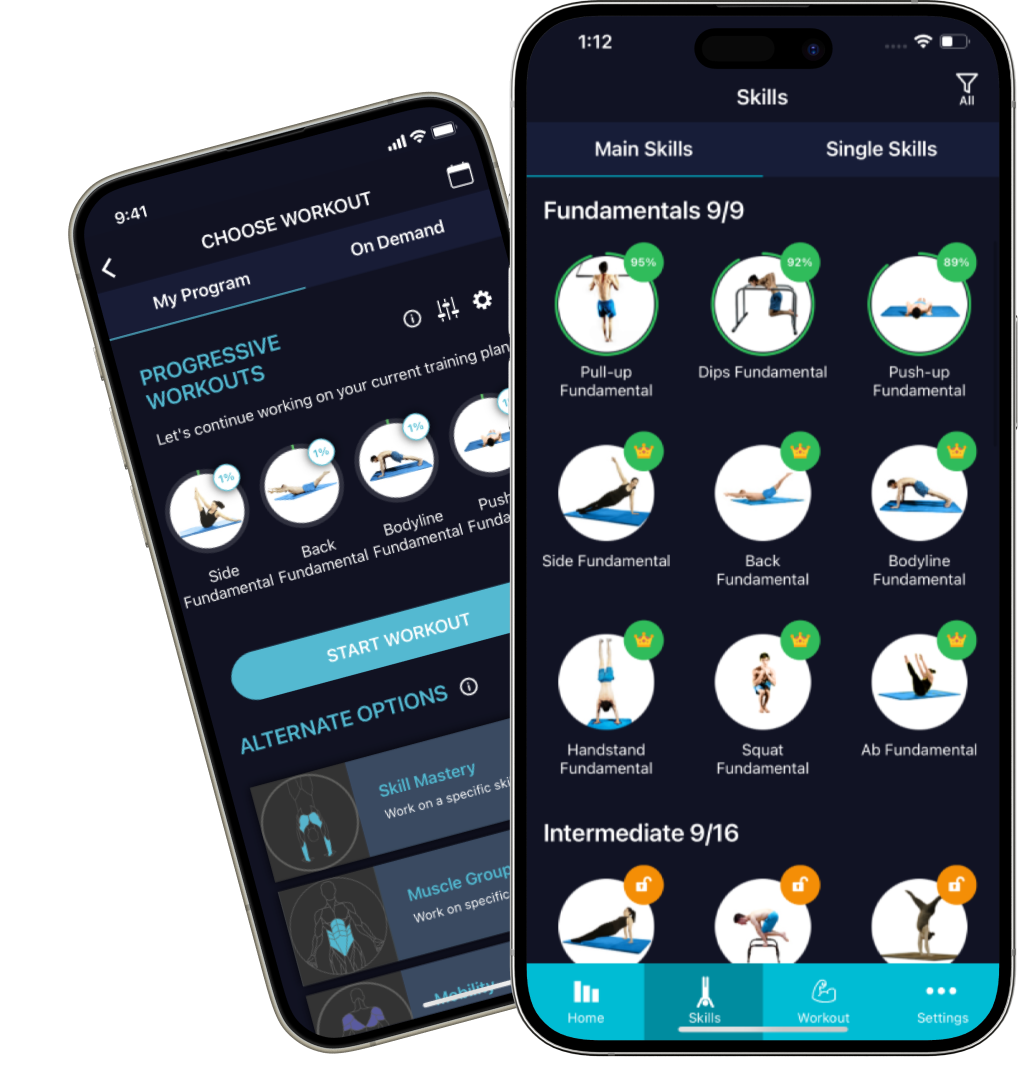
Fundamentals: establish the base across pushing, pulling, dips, handstand, core, side, back, bodyline and squat work.
Progression paths: connect preparatory variations to more demanding movements.
Main goals and supplementary moves: the movement map includes substantial skill journeys alongside variations, transitions and additional movement practice.
Mastery and unlocks: show programme progress and what becomes available next. Users may have manual controls; do not describe every unlock as an unchangeable safety restriction.
Repetition: staying with a variation can be purposeful. Progress can involve capacity or execution as well as a new exercise.
How to read the map: the pictured “Main Skills” are the larger progression goals; “Single Skills” are additional movements, transitions or variations. For example, the freestanding handstand screen shows a goal with its own prerequisites and hold progressions, then linked possibilities such as cartwheel to handstand or handstand walking. The screen illustrates the relationship, not a promise that every tile is an equally long standalone course.
More repetitions can contribute to development; a harder variation is another progression tool, not the only route to getting stronger. Do not interpret the illustrative ladder below as a universal sequence for every member.
Strength can progress through more capacity at a movement and through appropriately harder variations. Intermediate variations make the next step more manageable. Difficulty and adaptation vary by movement and person; a progression does not make tendons adapt at the same rate as muscle.
The idea is a manageable route forward, not a guarantee of preventing recurring injuries.
There are 100+ progression levels across the nine fundamentals, and a path from any one of them to the skills people assume are off-limits. An app with three difficulty levels cannot do this; it is not a smaller version of the same thing, it is a different thing.
What Members Actually Get
One connected training experience: assessment establishes the starting points; demonstrations guide the work; feedback adjusts the challenge; the progression map connects today's session to a longer journey.
What they actually get
Daily, progressive, personalised workouts
Tailored to their energy, their time and their equipment. Challenging enough to work, adjusted through their feedback to support progress over time.
An AI-driven holistic training plan
Mobility, skill, strength, muscle and endurance together — so the plan develops more than strength alone. No injury-free outcome is guaranteed.
Everything needed to master 100+ calisthenics skills
No more buying a course per skill. Beginner to advanced, in one place, as one journey.
A gamified progression system
Track progress, set goals, unlock skills. Visible milestones can make training feel like a game rather than only a discipline task. A retention ranking needs cohort evidence.
Train anytime, anywhere
Home or outside, minimal or no equipment, and useful even on a ten-minute day.
Product facts and publishing qualifications
Mechanism: small, structured microprogressions; do not publish 5–10% as a universal measured increase.
Scale: 100+ progression levels across the nine fundamentals; 2,000+ exercise variations; 100+ skills with full progression paths. Say “100+”, never an exact number — it grows.
Every workout contains six elements: warm-up & mobility, skill, strength, muscle, endurance, cooldown & flexibility. Never describe a TMA workout as fewer than six.
The free web quiz takes about three minutes and is free.
Proof: 100,000+ athletes · 4.8★ member rating (identify the source and scope; do not substitute a rating or attribute a blended rating to one app store) · 47 countries.
Credibility: built with physiotherapists, gymnastics coaches and elite calisthenics coaches; backed by the LEAD Sports Tech Accelerator, run by the Adidas family and ex-Red Bull executives.
Risk reversal: free trial, and a 60-day money-back guarantee.
🔴 Never claim it diagnoses, treats, flags or manages an injury or medical condition. It does not. Members make those calls themselves.
Framing the value
Do not lead with price. When price comes up, these are the honest comparisons — and note that the first two are about what the alternative costs, not what we charge.
Individual personal training can cost substantially more than app-based programming; prices vary by coach and service.
And a coach who programmes all five characteristics properly is rare at any price.
A single-skill course has a narrower scope. Historical $100–200 / eight-week examples require a named, current source before reuse.
TMA is 100+ skills, each a full progressive programme, and it does not end.
Short sessions can make consistent practice possible. Fifteen minutes, three times a week is an example schedule, not a universal results guarantee.
For time-poor audiences, show a realistic session and the available time settings.
🔴 Quote the comparison, never a specific total you have not been given. Figures like “$9,700 of content” circulate in our own older copy; they are a valuation of the library, not a price anyone ever paid, and we do not ask partners to defend them.
Practical membership expectations
Product fit: TMA supports strength, muscle, mobility and skill development. It is not medical rehabilitation, diagnosis, guaranteed live supervision or a specialist competitive-bodybuilding programme.
Practical requirements: TMA is available on iOS and Android. Many foundational exercises need little equipment; pulling progressions require a suitable bar or rings. Match your equipment claims to the movements shown, and let the member choose a sustainable schedule rather than promise a universal minimum dose.
Support: tutorials and programming guidance are not the same as a live personal trainer. Some articles describe community access and coach feedback; confirm the current membership entitlement before promising individual form reviews, video analysis or live coaching.
Access and billing: subscription membership and lifetime access are different purchase options. Use the current issued offer for price, trial, renewal and access terms. Do not lift an old article's valuation or price into new promotional copy.
Explain the combination, not an unsupported exclusivity claim. Other approaches can be effective. The relevant question is how much assessment, programming, adaptation and progression guidance the member receives, and what they must arrange themselves.
Alternative
What it can offer
The relevant TMA contrast
YouTube
Accessible tutorials, inspiration and detailed demonstrations.
TMA connects assessment, programme structure, feedback and progression; a collection of videos leaves those decisions to the viewer.
Generic fitness apps
Convenient guided workouts; some also personalise and adapt.
Show TMA's movement-specific starting points, microprogressions, holistic sessions and mastery map. Compare a named app's actual features before claiming an advantage.
Gym training
Effective strength and muscle training, including mobility when programmed.
TMA offers structured bodyweight skill development with integrated movement work. It can complement gym training; weights are not inherently harmful.
Single-skill courses
Focused coaching and a defined route towards a particular skill.
TMA combines multiple skill paths with ongoing adaptive workouts. A course may still be the right choice for someone wanting specialist depth on one goal.
Personal trainers
Individual judgement, live observation, technique correction and accountability.
TMA makes structured programming and feedback-driven adjustments available through an app; it does not replace everything a human coach can observe or provide.
Changing body position is a progression tool, not proof that external weights damage joints. The loading, execution and programming matter in both approaches; neither guarantees injury-free outcomes.
The mechanism, in thirty seconds, in words your audience will follow.
This is the part your audience has never had explained properly — and the part
you need to be able to say out loud in thirty seconds.
One way to progress is more external load. Another is to change body position, leverage or support.
TMA uses those bodyweight progressions within an assessed, adaptive programme.
The programming difference, not a verdict against weights. Machines can provide support and a constrained movement path. Bodyweight movements can require more self-support and whole-body coordination. Both can be useful; mobility and control depend on the exercises and programming.
Strength in a familiar lift does not establish readiness for every overhead movement or calisthenics skill. Assess the particular movement instead of inferring it from a lifting number.
Now the alternative. Take a push-up. Against a wall it’s easy. On your
knees, harder. On the floor, harder again. Feet raised, harder still. Same movement,
no equipment, and the difficulty climbs the whole way — because you’re changing the
angle of your own body instead of adding a plate.
And crucially, you’re holding your entire body together the whole time.
Depending on the movement and programming, the development goals include these six capacities:
Strength — the muscle doing the work
Control and stability — the coordination and self-support needed to maintain the position; not proof that machine training leaves all stabilisers weak
Mobility — relevant movement range practised within training, alongside targeted mobility work
Flexibility — range developed with the appropriate movements and the programmed cooldown and flexibility work
Joint and connective-tissue conditioning — gradual loading and recovery appropriate to the movement and person; changing body position does not by itself guarantee that connective tissue keeps pace or injuries are prevented
Nervous-system coordination — most early strength gain is your
brain learning to recruit muscle properly and fire it in the right order. It is also why
a skill suddenly “clicks” long before the muscle visibly changes.
You’re not training a muscle. You’re training the whole structure — the muscle, the
joint, the range and the wiring that drives all three — and the strength you build comes
with the control to survive using it.
The in-app assessment result: a member’s measured level on every movement — level
12 of 12 on push-ups, 4 of 11 on handstands. Nobody is “a beginner”; everybody is nine
different levels at once.
Proof Points and Real Member Stories
Evidence category
What to use and what it establishes
Product proof
Actual assessment, progression, workout and mastery screens demonstrate how TMA works. The existing library lists 2,000+ variations and 100+ skills; an exercise count alone does not establish effectiveness.
Scale proof
The kit's published figures are 100,000+ athletes and 47 countries. Keep the supplied wording and verify currency before a new placement; reach is not an individual-results guarantee.
Satisfaction proof
The kit supplies a 4.8-star member rating and attributed member stories. Identify the rating's source and scope; do not attribute a blended rating to one app store.
Credibility proof
Use the supplied coach, physiotherapist and accelerator references in their approved wording. Expertise and backing are not clinical evidence of injury prevention.
Risk reversal
Explain the applicable trial and 60-day money-back guarantee. These lower purchase risk; they are not proof that everyone achieves a particular result.
Choose a story that answers the audience's question
Jacques illustrates meaningful skill goals and the move towards broader capability. Andrew describes structure, recovery and staying on track without improving every session. These are individual accounts, not universal promises. Use only cleared quotations and assets supplied for partner use.
Asset and Proof Library
These existing libraries remain separate. Choose a resource by what your content needs to demonstrate: audience fit, a cornerstone, an objection or a format.
Check the resource's source, permission, date and offer before reuse. A designed testimonial card is not a raw screenshot. Historical creative performance is context, not a promise of your own results.
Connect each feature to a benefit and its evidence
Feature → what it means for them → how you prove it
Never sell the left column. Your audience does not want an assessment, they want to stop guessing. Say the middle column, and have the right column ready for the first person who pushes back.
Feature
What it means for them
How you prove it
The assessment
You stop guessing where to start. It tells you your actual level on every movement, not a label like “beginner”.
Walk them through the free web quiz, then distinguish the fuller in-app movement assessment. Show the actual starting points rather than implying both assessments take the same time.
100+ progression levels across the nine fundamentals
There is always a next step that is only slightly harder — so you progress with intermediate steps rather than an assumption that programme progress certifies joint readiness.
Name a specific ladder. Push-ups alone run from a wall push-up to a one-arm.
Micro-progressions (small, structured steps)
Small steps help organise loading; they do not establish identical tissue adaptation rates or guarantee freedom from injury.
The mechanism section — and Jesse's own story, which is exactly this lesson learned the hard way.
Autoregulation — it adapts every session
A bad night's sleep does not wreck your week. The plan meets you where you are that day.
This is the answer to “what happens when I fall behind”, which is the most common real objection.
2,000+ exercise variations
It does not run out, and it does not get boring in month three.
Contrast with the 8-week course they already finished and abandoned.
Skill unlocking
Training stops feeling like a chore and starts feeling like levelling up — which is why people stay.
The skill map. Show them a skill they think is impossible and the path to it.
Home or anywhere, with equipment matched to the movement
No gym, no commute, no waiting for a bench. The reason they stop quitting.
Their own calendar is the proof — ask them how many gym sessions they missed last month for reasons that had nothing to do with willpower.
Built with physiotherapists, gymnastics coaches and elite calisthenics coaches
It is not one influencer's opinion. It is a system with clinicians in it.
The LEAD Sports Tech Accelerator — run by the Adidas family and ex-Red Bull executives. Spell it exactly that way.
Free trial, and the first workouts included
They can find out whether it fits before paying anything.
This is your strongest cold CTA all year round, outside a discount window.
60-day money-back guarantee
The decision is reversible, which is the only thing standing between an interested reader and a click.
Say it in the last line of every promotional email. It converts the hesitant.
The test for any sentence you write: connect it to this customer, a specific product mechanism and credible evidence. A benefit can be valuable without an unsupported exclusivity claim.
Expectations, Objections and Answers
Question
Answer to communicate
What if a workout feels too difficult?
Use the difficulty feedback and appropriate variation. Do not treat prescribed work as an instruction to train through pain or ignore professional advice.
Why am I repeating exercises?
Repeated practice can be intentional while capacity develops. Variety is not the same as progress.
Will I improve every session?
Not necessarily. Autoregulation adjusts the challenge; progress is a longer-term trend that includes recovery and uneven days.
How soon will I learn a skill?
It depends on the starting point, skill requirements, practice and recovery. Show the path rather than promise a fixed deadline.
Use current offer terms for price and guarantees. Short sessions can make training practical, but no universal minimum dose guarantees results. Pulling requires suitable equipment; testimonial experiences are individual.
The questions your audience will actually ask
Answers you can use directly. Where a member quote is attached, it is a real one from our verified library — use those verbatim and do not invent others.
“Will this work for me? I’m too old, too out of shape, too advanced…”
Members run from their twenties to their seventies — engineers, parents, pilots, grandparents. Some had not trained in decades; some had trained for decades and hit a wall. The system starts with an assessment and meets them at their level, not at an influencer’s.
“I’m 68 and I can still compete with my grandsons, so I want to keep it that way.” — Carol, 68
“What if I don’t like it?”
Sixty days, full refund, no questions. They can use everything — all the workouts, all the progressions, all the skills — and still ask for their money back. Say this plainly; it removes the only real risk they are carrying.
“I’ve tried programmes before and always quit.”
Most people have, and the reason is usually the same: they were handed a PDF and some videos and wished luck. This adapts every session — too hard, it adjusts; too easy, it progresses; tired, it scales back. The programme carries the discipline so they do not have to.
“The single biggest thing is the way the app tries to be my personal trainer and create an experience tailored to ME.” — Daniel
“Is calisthenics really enough? Don’t I need weights?”
Flip it: do gymnasts look weak? Calisthenics builds real strength, lean muscle and mobility with loading matched to the member and movement. Members are not doing jumping jacks — they are working towards handstands, muscle-ups, planches and levers, which most gym-goers cannot do.
“My physique changed hugely, now I have a six-pack, my core is very strong, shoulders and upper body have grown quite a bit.” — Sean
“Will this help me lose fat or build muscle?”
Progressive resistance training supports muscle and strength goals alongside mobility. Fat loss also depends on nutrition, consistency and other factors; no particular body-composition result is guaranteed.
“I don’t have time.”
Neither do most members. Sessions run 20–45 minutes, three or four times a week, with no commute, no waiting for equipment and no class schedule. Home, a park, a hotel room, 5am or 11pm. Shorter sessions can make consistent training practical; no minimum dose guarantees results.
“Do I need equipment?”
Many foundations can start with little equipment. Pulling needs a suitable bar or rings. A pull-up bar and parallettes unlock more skills later, but no gym membership is ever required.
“Is this just another app? Who is behind it?”
It was built by a team of ten — gymnasts, calisthenics coaches, physiotherapists and sports scientists — over three years before release, and it has been refined against real results since. It is backed by the LEAD Sports Tech Accelerator, run by the Adidas family and ex-Red Bull executives. Spell that exactly.
Practical facts for answering objections
Age range of members: roughly 22 to 70.
Sessions: 20–45 minutes, 3–4× a week. A shorter schedule can support consistency; outcomes depend on the person and programme.
Many foundations need little equipment; pulling requires a suitable bar or rings. A pull-up bar and parallettes unlock more later.
60-day money-back guarantee — use the applicable current terms; no conversion ranking is established here.
Built by ten specialists over three years: gymnasts, calisthenics coaches, physiotherapists, sports scientists.
🔴 Never invent a member quote. Every quote in this kit is from the verified library; if you need one for an angle we have not covered, ask us.
How To Talk About It
What The Movement Athlete is — and how to say it
THE PROMISE
To take you from wherever you are now to the healthiest, strongest, most capable version of yourself — with progressive calisthenics.
That is the promise. Everything below is how we keep it. If a piece of your copy does not ladder up to that sentence, it is not our message.
The definition — the product in plain English
The Movement Athlete Academy is a lifelong progressive calisthenics system — built to make you stronger, more mobile and more capable over time, while you learn over 100 real calisthenics skills.
Structured, deeply personal, and built to work for years, not weeks.
Three ways to say it shorter
One line: training that starts at your exact level and adjusts the challenge through your feedback.
For people rebuilding confidence: progressive strength and mobility work, with medical decisions left to qualified professionals.
For the stuck: a hundred-plus steps between where you are and the skill you want — so there is always a next one.
One sentence
TMA is a personalised calisthenics training system that gives you a movement-specific starting point, structured next steps and workouts that adjust through your feedback.
How we deliver the promise
Your strength, mobility and skill are not all at one level. TMA starts from your current abilities, builds a path through manageable progressions, includes mobility and flexibility within the training, and uses your effort feedback to adjust the challenge. The mastery map gives that practice a visible purpose.
Say this
Not this
A movement-specific starting point
A beginner workout app with the same plan for everyone
An ongoing progressive calisthenics system
A fixed challenge that guarantees mastery in eight weeks
Adjusts the challenge through your feedback
Automatically knows your sleep, pain or joint readiness
Build strength, mobility and control together
Fix injuries or guarantee pain-free joints
Small, structured steps towards harder movements
A measured percentage harder at every step, without evidence
Package the product for your channel
Channel
Angle and what to show
YouTube
Review the actual journey: assessment, a real workout, feedback, progression and honest limitations.
Instagram Reel
Show two appropriate variations and the progression screen. Explain the manageable next step, not a promised transformation date.
TikTok
Hook: “Strong at push-ups, new to handstands? You are not one fitness level.” Show the different starting points.
Email
One audience problem, one cornerstone, one cleared member example and one approved CTA.
Newsletter
A concise personal recommendation with a relevant demonstration; distinguish your experience from a member's story.
Blog / SEO
Answer a specific fit or comparison question with current screenshots, practical requirements, trade-offs and FAQs.
Podcast
Explain why a single fitness label is insufficient, how small progression steps work and what feedback changes. Give the issued link or supported code clearly.
Default CTA: “Take the free quiz to explore where to start.” Use your issued tracked link. For the supported 50% offer, the customer can use the tracked offer link or enter the issued partner code at checkout. Keep trial and discount wording separate.
Choose one angle per piece of content. Benefits describe training goals; pain, joint protection and body-composition results are not guarantees. Use the qualified wording in the claims guide when adapting the angle bank.
The eight angles — and the benefit each one sells
Each row is a complete angle: the promise, why it is true, and who it lands with. Pick one per piece of content.
Angle
Why it is true
Lands with
Real-life strength over gym strength
You get stronger in everyday basic movements, so you move freely in the world — rather than strong in positions that only exist in a gym.
Lifters who feel capable in the gym and fragile outside it
Joint capacity and movement confidence (not injury-proof joints)
Appropriately programmed loading can develop strength and control. Joint stress depends on the movement and load, not simply whether weights are used.
Anyone over 35, anyone with a history
Body control and awareness
Getting strong is one thing. Being able to control your body is another — and it is the thing people actually envy.
Skill seekers, former athletes
It forces you to train mobility and flexibility
Range is inside every rep, so ageing doesn’t quietly shrink what you can do.
Desk workers, the stiff, the over-40s
Recovery and balanced development (not injury-proofing)
Strength, mobility, flexibility, control, awareness and endurance together give you a balanced body — not the lopsided one an incomplete workout builds.
The injured, the twice-injured
A lean physique that supports you
Muscular but lean, in proportion, naturally fit — a body that serves the movement.
Aesthetics-led readers (most of the market)
Build muscle and lose fat, naturally
Progressive resistance training supports muscle and strength goals. Fat loss also depends on nutrition and other factors; simultaneous change is not guaranteed.
Fat-loss intent, beginners
Have fun, and learn genuinely cool skills
Long-term fitness matters, and sometimes you just want a check-me-out move. The progressions are built so a human flag or a handstand is a sequence, not a lottery.
Skill seekers, the bored, social audiences
How to use this table: your audience has one of these problems, not eight. Pick the row that matches them, write the whole piece from that row, and let the other seven go. A piece that argues all eight persuades nobody.
Claims To Avoid
Category
Publishing guidance
Product explanations
Describe movement-specific assessment, structured progressions, effort feedback, integrated mobility and flexibility, and the mastery map as demonstrated in the product.
Use with qualification
Muscle-building, mobility improvements and real-life capability are training goals, not identical outcomes for every person. Member stories remain individual experiences.
Never promise
Injury-proof or bulletproof joints; guaranteed pain-free outcomes; medical diagnosis or rehabilitation; automatic form correction or joint-readiness assessment without a verified feature; guaranteed mastery by a fixed date.
Numbers and comparisons
Use current sourced figures. Do not turn selected stories into conversion rates or revenue shares, describe every competitor as static, or assert that weights inevitably damage joints.
Offer and referral facts
Quiz tracking is confirmed. Use the issued link and supported code. Match the price, trial, guarantee and renewal language to the actual offer; do not create deadlines or codes.
Disclosure and proof
Clearly disclose the commission relationship. Use supplied, cleared testimonials as attributed; never invent a member, imply an AI presenter is a customer, or present artwork as an authentic capture.
Before publishing: check the actual offer, sourced figures, asset permission and disclosure. Aspirational phrases are not permission to make medical, safety or guaranteed-results claims.


 1. Warm-up & mobilityPrepare and practise movement range.
 2. SkillPosition, balance and control.
 3. StrengthAppropriately challenging work.
 4. MuscleProgrammed resistance-training volume.
 5. EnduranceSustain the work or position.
 6. Cooldown & flexibilityFinishing work and flexibility practice.